

15 PR tips from a Government press office (that you can use today)
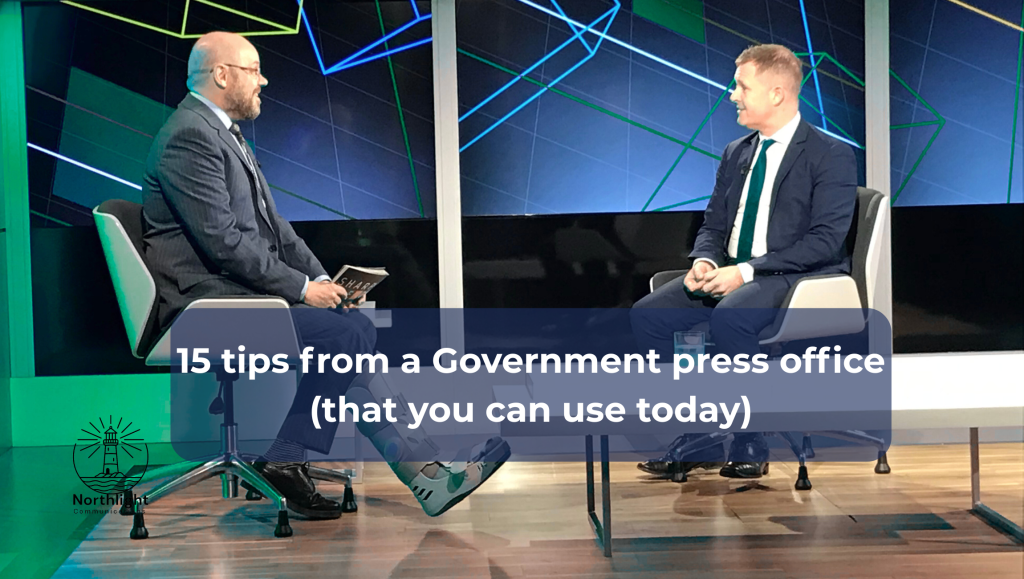
15 PR tips from a government press office that you can use today
These tips from a government press office can be used straight away, and can make your PR and communications better and more effective.
Working in a government press office is one of the toughest and most rewarding training grounds in communications.
It teaches you A LOT about people, politics, pressure, and priorities.
During my two years in the Welsh Government press office, through the Brexit transition, and the Covid-19 pandemic (I picked my time well), I learned lots and picked up lots of tips about media relations, communications, and finding (and selling in) a story.
After Welsh Government, I handled reactive media through the early months of the cost of living crisis in the UK Gov Dept for Business, Energy, and Industrial Strategy (which was divided up into various new government departments).
Government communications moves fast. Priorities shift in minutes, and sometimes politicians change policy at short notice.
Every word matters.
So does timing, audience, channel, tone and context.
These tips apply everywhere, not just in government communications.
Best practice in media relations means just that. These are the guidelines that make media relations work properly, especially in environments where you’re communicating with a wide community audience.
Here are 15 practical and useful tips that you can use today to make your PR and communications better – and your work easier and more fun.
15 press office tips to take on board today
1. Keep a lookout
‘Horizon scanning’ is a full time job. It’s vital to keep an eye on social media and the news cycle, all the time.
When something major breaks, your best-laid plans might suddenly be inappropriate.
Be ready to pause or pull a story.
Getting that wrong can undo years of reputation-building overnight.
2. Mood matters
Sometimes a story you think will land well just… doesn’t.
Be ready to adjust the tone, timing or message based on how people respond.
3. Who is your audience?
National messages have to resonate with communities, individuals, and diverse groups.
The audience for those messages still isn’t ‘everyone’, but it’s a lot close to ‘everyone’ than for most comms.
Partner with external teams and third sector organisations to find the people who can help you test and clarify your message.
Include their authentic stories and real voices. Capture the views of individuals and groups who represent the different regions, backgrounds and experiences of people you need to reach.
Press-office-written soundbites don’t work. They will alienate the audience.
Only honesty and authenticity will create the buy-in you need.
4. Journalists are your allies
Build strong media relationships.
When you need to get an urgent message out, those trusted contacts make all the difference.
Take the time to understand what they need, and then deliver it, in the way and at the time that suits them best.
It’s a very symbiotic relationship. Make it good for them, and good for you.
5. Laugh – otherwise you’ll cry
Government comms can be intense.
Reactive media can be especially stressful, but not everything has to be serious.
Our Welsh Government press office team used to unwind with crosswords over lunch – it kept us together (in more ways than one) through Brexit and Covid.
Laughter kept morale high, and perspective in place.
It’s really important to keep a bit of distance between the (sometimes distressing) real life stories you’re dealing with, and your own ‘real life’.
When the news is your daily life, you need to have a ‘safety valve’, and time away from the news: no matter how serious the topic is, you’re allowed to laugh.
Maybe a swear box would work for your office, or an ‘innuendo bell’ to lighten the tone when those unintentional innuendos, ahem, keep coming up.
Laughter does you good, and makes the quality of your life (and therefore your work) better. Don’t underestimate the need to laugh.
6. Get the message straight
Before any message goes public, make sure every adviser, partner, and spokesperson knows and agrees to what’s being said.
Mixed messages damage trust and waste time.
7. And related to that… clearance matters
Follow the sign-off process faithfully.
It might feel bureaucratic, but it’s essential.
Messages of national importance impact on everyone.
If you get it wrong, your neck (and career) might be on the line – it’s that important.
The clearance process is there to protect you.
8. Plan ahead
Use forward plans or grids to schedule upcoming announcements and projects.
Strategic planning makes best use of everyone’s time and energy.
Scheduling clashing stories is a totally avoidable mistake – as is missing an important anniversary or event.
Government press offices generally hold weekly ‘grids’ meetings which bring together the leads for each politician, project, and policy area, who run through a detailed programme for the next week or two, plus a less detailed forward plan for the next four weeks.
Working together, it’s easy to spot and plan for risks, partnerships, and opportunities, and to stay ahead of the predictable news cycle. And that means you’re ready to respond quickly when breaking news hits.
9. Not everything is a crisis
Challenges aren’t all emergencies, and complaints don’t always need a response.
A negative comment on social media might be best ignored: the saying ‘don’t feed the trolls’ is firmly grounded in communications best practice, and common sense.
Often the best response is calm and dignified silence.
NB There are also times when an honest, transparent, firm response is needed. An experienced professional will know the difference and be able to advise on the best response.
10. Reactive media needs a quick turnaround
Reporters work to tight deadlines. Pick up requests for reactive statements straight away, and act on them.
In situations where you might face multiple queries, national and broadcast media requests generally take priority, with regional and trade media next on the list.
Start with a quick message asking for clarity on the deadline (if necessary), and any asks you aren’t clear on. That way, the reporter will know you’re actioning their request.
Then draft the response, get it cleared, and issue it ahead of the deadline.
It’s nearly always best to include your perspective in a published story, if you’re asked for it.
‘X was asked for a comment’ in a news story means ‘was asked, and failed to respond’.
That isn’t (usually) a very good look.
Reputation as a leader or influencer can be lost much faster than it can be gained.
11. Find the human angle
Even the most complex policy has a human story behind it.
That’s what makes people care, and what makes communications powerful.
Work with your partners in the third sector or local authority to find real people to speak to. Gather authentic stories, create case studies, and use emotion to build engagement.
Examples of policies or behaviours being successfully adopted are the best way to encourage people to act and think in the way you want.
Successful behaviour change relies on authentic storytelling.
12. Stay off camera (or buy cake)
There’s a firm rule in most government press offices: if the press officer gets caught on camera, they owe the whole press office cake.
It’s a reminder to stay focused on the spokesperson and they key messages, and to be aware of exactly what’s going on.
It’s a humorous way to hold people responsible.
13. Keep the briefing brief
Government press office work will include a lot of media interview bids and briefings.
Whenever an interview bid comes in, get clarity on the topic and format, and advise your spokesperson on whether the interview will meet and progress policy and strategy.
Once agreed, you’ll prepare a briefing document, including expected questions, and (usually) 3 clear key messages which represent the points which need to be made during the interview.
These are the points which the spokesperson will come back to and emphasise.
Some spokespeople like to run through the interview questions in advance, others prefer to prepare alone.
You’ll usually attend the interview with the spokesperson for support and feedback. Occasionally, you might need to bring the journalist back to the agreed line of questioning. Generally you’ll debrief afterwards.
One Minister I used to work with always asked whether he’d changed any policies by mistake. He was a consummate professional, and never did.
14. Find creative ways to launch policies
Policy announcements don’t have to be dry or boring.
Find a location or format that makes the message memorable – a spokesperson visit to a barber shop, a youth club, or a local business.
An authentic connection and creative opportunity makes policies real.
15. Build partnerships everywhere
You’ll often need quotes or support from partner organisations, charities, or service users.
Strong relationships built over time make collaboration easier, and stories more powerful.
Partners are also well placed to suggest individuals who can offer case studies or authentic stories.
And case studies and authentic stories make it more likely that reporters will place your news piece.
Final thoughts
Working in a government press office is a masterclass in media relations, broadcast interviews, crisis planning, events handling, audience insight, and staying calm under pressure.
But these 15 PR and communications tips go way beyond politics and government.
Whatever sector you work in, the same principles apply.
- Listen carefully
- Respond quickly
- Plan ahead
- Build partnerships
- And always keep the human story at the heart of your message.
ENDS